The Day Marjane Satrapi Chose Art Over Silence
We all have a moment that splits our life into a “before” and “after.” For Marjane Satrapi, that moment wasn’t just a personal heartbreak; it was the death of a familiar world. Long before Hollywood animated her life, she was a young girl watching missiles rain down on Tehran, a punk rock teenager rebelling against the regime’s morality police. Her weapon wasn’t a Molotov cocktail—it was a sharp, unflinching pen. In a media landscape hungry for black-and-white narratives about Iran, Satrapi gave us something far more precious: the messy, authentic, and profoundly human grey area.
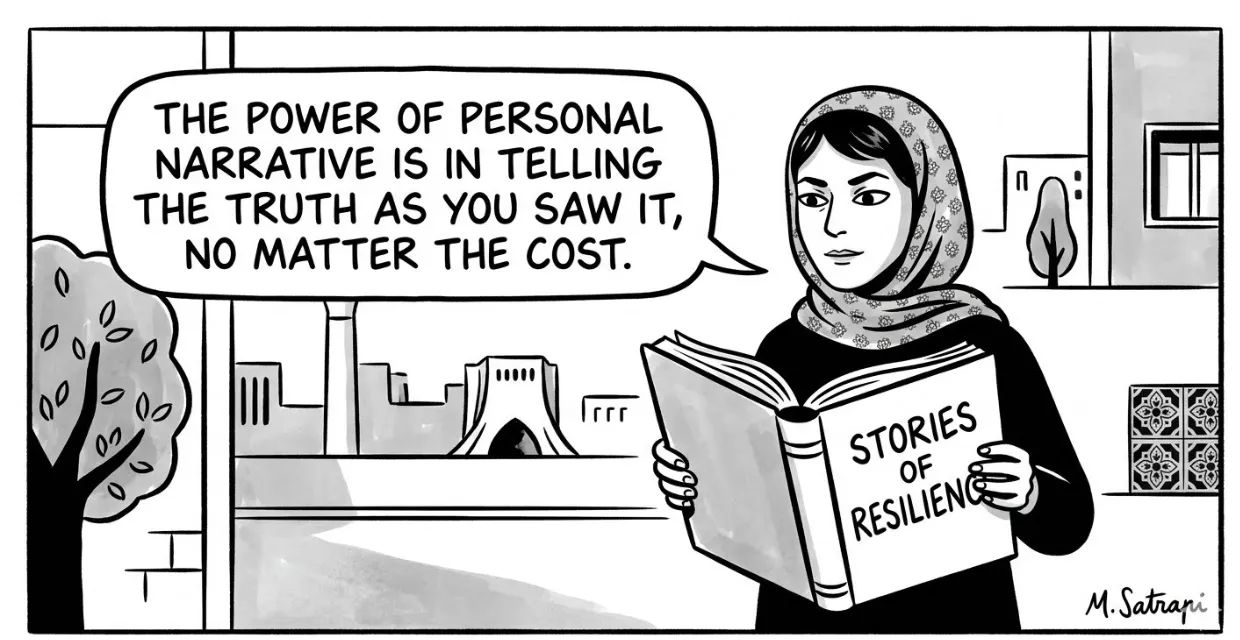
Drawing the Unspeakable: How a Childhood Became Universal
We often think of graphic novels as escapism, filled with caped heroes. But in Persepolis, Satrapi turned the genre into a mirror, reflecting a childhood punctuated by political assassinations, torture, and a violent war. The visual starkness—pure black ink on white paper—was a stylistic choice born of necessity and genius. It bypasses cultural clichés and speaks directly to the limbic system of the brain.
The Punk Spirit of a Revolutionary Generation
Under the chadors and the compulsory headscarves, Satrapi cultivated a rebellious spirit that Western teenagers instantly recognize. She smuggled Iron Maiden posters, wore a denim jacket with Michael Jackson buttons, and risked arrest just to buy bootleg music on the black market. This isn’t just nostalgia; it’s a masterclass in identity preservation. Her story asks a timeless question: when external authority tries to crush your inner self, where do you find freedom? For Satrapi, it was in the hidden margins of a forbidden sketchbook.
Exile and the Unbearable Weight of Memory
Satrapi’s physical journey to Vienna was supposed to be a liberation, but it morphed into a different kind of prison. Estranged from her language, her family, and even her own reflection, she experienced a homelessness that had nothing to do with a roof. This segment of her life reveals a raw vulnerability that statistics about refugees often miss. She wasn’t just fleeing a war zone; she was grieving a version of herself that could no longer exist. The soil of exile, as she shows us, is fertile ground for both self-destruction and eventual rebirth.
Why This Matters Now More Than Ever
In 2024, as global censorship tightens and the world witnesses a fresh wave of defiance led by Iranian women, Satrapi’s visual vocabulary has become a script for the present. Her work is no longer just a memoir of the 1980s; it’s a strategic blueprint for dignity. The recent “Woman, Life, Freedom” movement operates on the very principle Satrapi perfected: that the body, uncovered and expressive, is the most effective canvas for political protest. She taught an entire generation that you can be terrified and still be absolutely ungovernable.
The Lie of “Representation” and the Truth of Authenticity
Satrapi resists the crushing label of being the voice of her nation. She argues that a country of 80 million people doesn’t have a single spokesperson, and this refusal to generalize is her ultimate act of journalistic integrity. She didn’t create Persepolis to explain Iran to the West; she created it to explain the universal absurdity of death, the pangs of first love, and the crushing comedy of being human. That is the secret of her longevity. Audiences aren’t stupid; they can smell propaganda from a mile away, but a genuine, self-deprecating human truth? That’s irresistible.
The Monsters We Defeat, And the Ones We Befriend
We often expect stories of political trauma to end with a triumphant vanquishing of the enemy. Satrapi gives us a more mature conclusion. She teaches us that the real victory isn’t in killing the monster, but in proving the monster failed to make you like itself. Despite the horrors she witnessed and the grandfather she lost to a firing squad, her work is almost entirely free of vengeful hatred. It burns with a love for life—for the taste of a good cigarette, the rustle of a silk hijab, the absurdity of a philosophy lecture.
Final Reflection
Marjane Satrapi’s legacy is not just ink on paper; it’s a survival guide for the soul. She proves that memory is a form of justice, and that drawing a single, honest line is sometimes the loudest act of defiance in a world determined to silence nuance. In an age of algorithmic outrage, her voice—dry, melancholic, and sharply witty—reminds us that the most radical thing we can do is hold onto our own complex, contradictory stories. The panel may be black and white, but the courage she inspires is a brilliant shade of fire.