

From hundreds of kilometers above Earth, the view of India feels almost unreal.

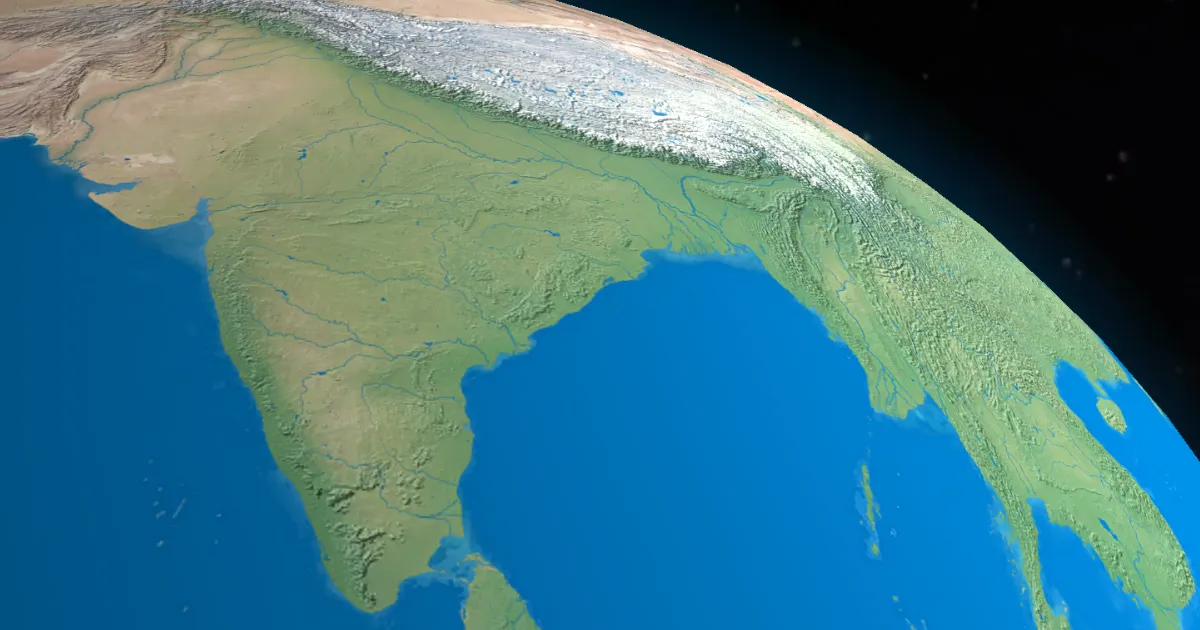
Golden deserts, glowing cities, winding rivers, and the towering Himalayas appear like strokes on a giant canvas. For astronauts and satellites, India is not just a country—it’s a living, breathing landscape that tells a powerful story from space.
And once you see India from space, you never look at it the same way again.
The First Time Humans Saw India From Space
When astronauts began orbiting Earth during early space missions, they described India as one of the most visually striking regions on the planet.
The massive Himalayan mountain range forms a natural border in the north, appearing like a frozen white wall from orbit. Meanwhile, the fertile plains of the Ganges glow with deep green during the monsoon season.
Satellites operated by organizations like the Indian Space Research Organisation and the NASA have captured thousands of high-resolution images revealing this incredible landscape.
These images are not just beautiful — they also help scientists understand climate change, urban growth, and natural resources.
What India Looks Like at Night From Space
If daytime images of India are stunning, nighttime views are even more magical.
From orbit, India becomes a network of glowing lights. Cities like Delhi, Mumbai, Bengaluru, and Kolkata shine brightly, forming clusters of light visible across the subcontinent.
One of the most fascinating features is the glowing arc along the Indo-Gangetic Plain — one of the most densely populated regions in the world.
Astronauts often say that the Indian subcontinent looks like a luminous island surrounded by darkness when viewed from orbit.
The Geography of India Revealed From Orbit
The Himalayas: Earth’s Natural Wall
The towering Himalayas dominate the northern boundary of India.
From space, they appear as a massive white ridge separating the Indian subcontinent from Central Asia. Their snow-covered peaks reflect sunlight, making them one of the brightest features visible from orbit.
The Thar Desert’s Golden Signature
In the northwest, the Thar Desert looks like a vast golden sea.
Its sandy patterns and shifting dunes create unique textures that satellites can easily identify.
Rivers That Shape Civilization
The winding paths of the Ganges River and Brahmaputra River appear like silver threads cutting across the landscape.
These rivers have supported civilizations for thousands of years and remain lifelines for millions of people.
Satellites That Capture India From Space
Modern satellites make it possible to monitor India continuously from orbit.
The Indian Space Research Organisation operates advanced Earth-observation satellites that track weather, agriculture, forests, and disasters.
Meanwhile, programs run by NASA and global space agencies provide open satellite imagery that allows anyone to see India from space using platforms like satellite maps.
These images help scientists track monsoons, floods, and even air pollution patterns across the country.
Why Images of India From Space Are Going Viral
In recent years, space photos of India have exploded across social media.
People are fascinated by how familiar landscapes look completely different from orbit. A glowing night skyline, a monsoon-covered forest, or a snow-covered Himalayan chain can spark millions of views online.
Part of the appeal is emotional. Seeing a nation from space reminds us how small borders are compared to the planet itself.
It’s a perspective that feels both humbling and inspiring.
Why This Matters Now
Today, satellite imagery plays a crucial role in solving some of humanity’s biggest challenges.
From monitoring climate change to predicting extreme weather, space technology helps governments and scientists make smarter decisions.
For India, one of the fastest-growing economies in the world, satellite data is also shaping agriculture, urban planning, and environmental protection.
The same images that amaze us online are quietly helping build a more sustainable future.
A View That Changes Everything
Looking at India from space offers something deeper than a beautiful photograph.
It reminds us that a country of more than a billion people, thousands of languages, and centuries of history fits into a single breathtaking frame.
From orbit, the deserts, rivers, mountains, and cities blend into one magnificent landscape.
And in that moment, Earth stops feeling divided — it simply feels like home. 🌍